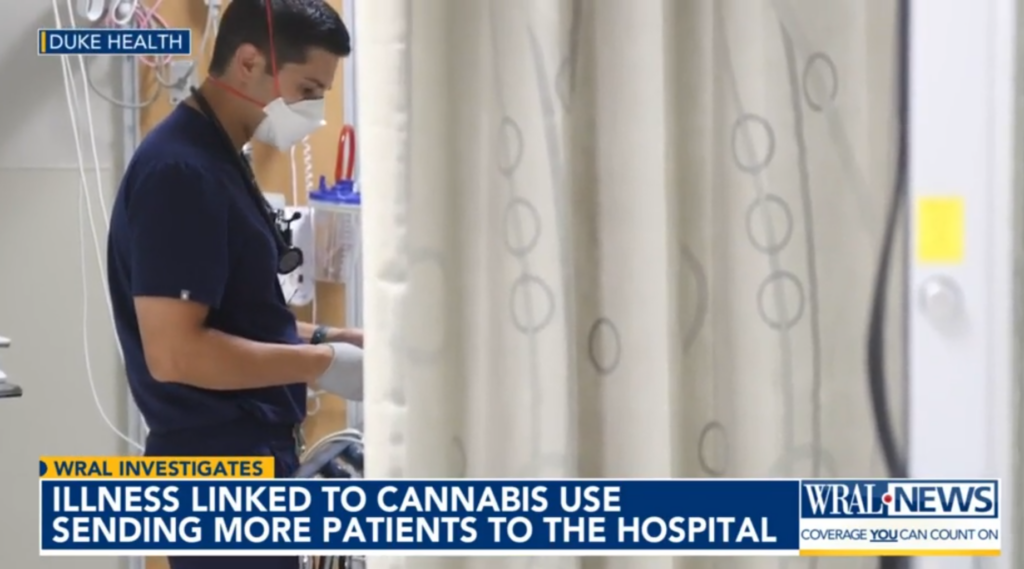
Jill Fuller thought she was making a healthier choice. Instead, the decision cost her three months of her life, a hospital stay, and a recovery so brutal that even broccoli made her sick.
Reported by Grace Hayba for WRAL Investigates in July 2025, Fuller’s story is one of a growing number of cases unfolding across North Carolina and the broader United States as THC edibles, sold legally and with virtually no restrictions, expose unsuspecting consumers to cannabinoid hyperemesis syndrome, a condition most of them have never heard of.
“I thought I was doing something legal”
Fuller, 57, had been drinking a glass of wine most evenings for years. At some point she decided to make a change. “I started thinking, ‘I don’t want to be drinking wine every night, why don’t we try the store down the street?'” she told WRAL. The shop didn’t look like what she pictured when she thought of cannabis retail. “It’s not one of those typical vape stores where you see red and green flashing lights. It looked like a healthy store.”
An employee helped her select THC gummies to take each night before bed as a substitute for alcohol. At first, one gummy was enough. Over the following months, her tolerance climbed. One gummy became six. She went back and asked for something stronger and was sold a THC caramel.
The crisis arrived at work, without warning. In the middle of lunch, Fuller became intensely nauseous. She couldn’t stop it. She ended up in the emergency room.
The diagnosis was cannabinoid hyperemesis syndrome. What followed was ninety days of illness so severe that ordinary foods triggered symptoms. She survived on a BRAT diet: bananas, rice, applesauce, and toast. She moved back in with her 92-year-old mother to recover. A friend who witnessed the ordeal described the experience of watching it unfold: “We had no framework for this syndrome or how to manage it, so on top of seeing how much pain she was in and how little control anyone had, it was deeply unsettling that the primary advice was simply to wait and let time pass.”
The friend added: “What made it even more alarming from the beginning was that Jill had never experienced any major medical issues or trauma before. We had no idea what to think or why she was suddenly facing such serious problems.”
By the time it was over, Fuller had been prescribed more than a dozen different pain and nausea medications. She had one message for anyone considering THC products: “I thought I was doing something legal. I don’t smoke pot; I went to a store and bought these. I had no idea what I was doing to myself.”
Inside the ER: what doctors are seeing
Dr. Joshua Ring, associate medical director of education at Duke Regional Hospital in Durham, has become increasingly familiar with CHS presentations. The condition, he notes, has technically existed for over two decades, but it was never widely studied or discussed. “For some reason, it has not been widely popularized. Prior to COVID, there were a few papers that came out about it.” As cases continue climbing, he expects the science to follow.
When a patient with suspected CHS arrives, Ring says the first step is bloodwork to assess dehydration and electrolyte imbalances, both common consequences of sustained vomiting. IV fluid replacement is a priority, particularly when the patient cannot keep anything down.
Anti-nausea medications are frequently prescribed, though their effectiveness against CHS specifically remains inconsistent and not fully understood. The definitive treatment, the only one that reliably works, is complete cessation of all cannabis use. Ring says most patients begin to feel meaningful improvement within 24 to 48 hours of stopping.
The complication, he says, is what happens after discharge. “One of the problems is some patients do get temporary relief from smoking again. Once we discharge them, they’ll smoke because it makes them feel better for a short period of time, but then it’s just going to continue.”
THC potency: a 307% increase since 1995
The University of Mississippi’s Potency Monitoring Project, a program contracted by the federal government to track THC levels over decades, provides the clearest data on how dramatically the drug has changed. In 1995, the average THC content in cannabis products seized by the DEA was 3.96%. By 2022, that figure had risen to 16.14%, an increase of more than 307% in under three decades. Concentrated extracts and high-potency edibles available in retail settings today frequently exceed those averages by a wide margin.
Colorado became the first state to legalize recreational cannabis in 2014, generating over $300 million in cannabis tax revenue by 2019 alone. Around the same period, documented CHS cases began climbing in tandem with expanding retail access.
“No age restriction on who can buy those products”
North Carolina has not legalized recreational cannabis, but that hasn’t prevented high-potency THC products from reaching consumers, including minors. During an interview with WRAL, then-Attorney General Josh Stein described what unregulated access looks like on the ground:
“In North Carolina, everywhere — if you go to a vape shop on Hillsborough Street, on Peace Street, three doors down from Broughton High School — you can get a hemp product, a cannabis product, with intoxicating THC. There is no age restriction on who can buy those products.”
“We’ve got kids able to buy intoxicating cannabis, we’ve got adults buying it, having no idea what’s in that product,” Stein continued. “I believe adults should be able to choose what they want to do, but they need to have information, they need to be protected, and the public needs to be protected.”
Stein has been part of a regulatory review examining state cannabis policies and possible paths toward structured legalization with consumer protections built in.
For Fuller, the policy debate is secondary to the personal warning she now feels compelled to share. “It’s just something I will never return to,” she said of cannabis products. After ninety days of recovery, a BRAT diet, and more than a dozen medications, she had learned something the store that sold her those gummies never told her.
Selected clinical references
- AGA Clinical Practice Update on CHS diagnosis and management (2024)
- NCBI Bookshelf: Cannabinoid Hyperemesis Syndrome
- Cleveland Clinic: CHS symptoms, causes, and treatment
Sources are selected for the topic of this page. CHS SOS provides general education, not diagnosis or individualized medical advice, and does not describe content as medically reviewed unless that is explicitly stated.
Questions readers often ask
What is the main takeaway from “She Swapped Wine for THC Gummies to Be Healthier. It Landed Her in the ER for Three Months.”?
Jill Fuller thought she was making a healthier choice. Instead, the decision cost her three months of her life, a hospital stay, and a recovery so brutal that even broccoli made her…
What pattern makes CHS different from occasional nausea?
CHS is associated with prolonged cannabis exposure and a recurring pattern that may progress through prodromal, hyperemetic, and recovery phases. Hot bathing behavior is common, but no single symptom proves CHS.
What should I do next if I am still unsure?
Use the CHS Symptom Check to organize the pattern, review the CHS Action Plan, and bring your timeline to a qualified clinician. Seek urgent care now if severe vomiting or dehydration warning signs are present.
Medical disclaimer: CHS SOS provides educational information and does not diagnose or treat medical conditions. Seek advice from a qualified healthcare professional.