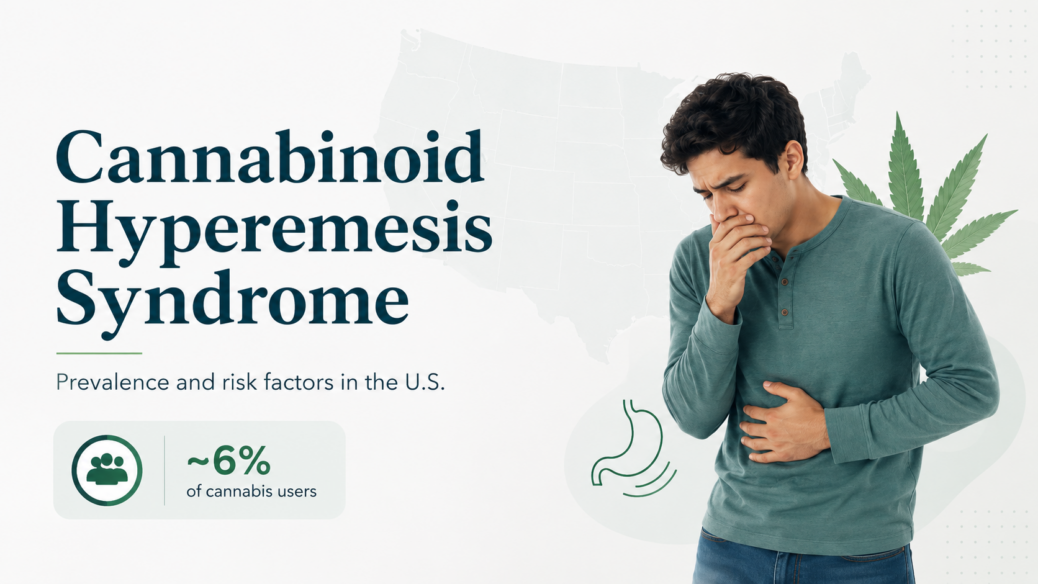
For the first time, a nationwide U.S. study confirms what the CHS community has been saying for years: 1 in 16 cannabis users may already be living with Cannabinoid Hyperemesis Syndrome, and most don't know it yet.

"For the first time, a nationwide study confirms what the CHS community has been saying for years: this is not a rare condition. It is a hidden epidemic."
CHS Patient Community- ▸A new study analyzed 10,255 U.S. cannabis users from the 2023 International Cannabis Policy Study (ICPS).
- ▸6% reported past-year CHS, roughly 1 in 16 active cannabis users.
- ▸Around 8% reported lifetime CHS symptoms, suggesting an even larger affected pool.
- ▸Risk is highest in younger users, men, and people with cannabis use disorder.
- ▸State legalization status had no significant effect on CHS prevalence.
A Landmark Nationwide Study
 10,255 surveyed · ICPS 2023
A new peer-reviewed paper published in the International Journal of Drug Policy represents the first large-scale, nationally representative analysis of CHS prevalence in the United States. Until now, almost everything we knew about how common CHS truly is came from emergency room observations and small case series.
The researchers analyzed survey responses from 10,255 cannabis users who participated in the 2023 ICPS. The mean age was 39.5, and 45.8% were female. A real cross-section of cannabis users, not just hospitalized patients.
What they found shifts the conversation entirely. CHS is not a rare quirk affecting a handful of unlucky users. It is a measurable, prevalent public-health concern hiding in plain sight.
The Numbers That Change Everything
The headline figures put the scale of CHS into sharp focus. These are not estimates from one hospital. They reflect the broader U.S. cannabis-using population.
In real-world terms: with tens of millions of Americans using cannabis regularly, a 6% past-year rate implies millions of people currently experiencing the syndrome. Many undiagnosed, mislabeled, or cycling through ERs without answers.
Behind the data: the 2023 International Cannabis Policy Study
The figures driving this analysis come from the International Cannabis Policy Study (ICPS), a recurring web-based population survey running annually since 2018. Its 2023 wave captured one of the largest, most demographically representative samples of U.S. cannabis users ever assembled for prevalence research.
Behind every percentage point in this study is a person. Someone who spent years vomiting, taking compulsive hot showers, and being told by doctors they were "fine." 6% is not a number. It's a community.
Who Is Most at Risk?
The study didn't just count cases. It identified the demographic and behavioral patterns most strongly associated with CHS:
- Younger age: Users in their 20s and early 30s reported significantly higher CHS rates than older participants.
- Male sex: Men were more likely than women to report CHS symptoms in the past year.
- Cannabis Use Disorder (CUD): Participants meeting criteria for problematic use showed dramatically elevated CHS prevalence.
- Higher-frequency use: Daily and near-daily users were the group most consistently affected.
- Concentrate use: Riskier consumption patterns, including high-potency products, were tied to higher CHS reporting.
Legalization Is Not the Driver
One of the most politically loaded questions in cannabis research is whether legalization itself is fueling adverse health outcomes. On CHS specifically, this study delivers a clear answer: state-level legalization status had no significant effect on CHS prevalence.
CHS appears across the country wherever heavy chronic cannabis use exists. What matters is not the legal status. It is the pattern of use: frequency, potency, duration, and individual susceptibility.
This finding reframes the public-health response. Prevention, education, and clinical screening must focus on use behaviors, not on regulatory borders.
What This Means in Practice
🏥 For Clinicians
CHS should now be routinely included in the differential for any patient with cyclic vomiting, particularly young men with cannabis use history. Asking about cannabis is no longer optional.
🌿 For Cannabis Users
If you are a daily user with unexplained nausea, vomiting, or compulsive hot-shower behavior, CHS is far more likely than you may have been told. You are not alone. Millions share these symptoms.
📜 For Policymakers
Legalization status alone does not predict CHS prevalence. Effective policy must address use patterns, product potency, and consumer education, not simply legal frameworks.
🔬 For Researchers
A 6% prevalence rate in the general cannabis-using population justifies major investment in mechanistic, genetic, and longitudinal CHS research. The case for funding is now data-driven.
Frequently Asked Questions
QIs 6% really that significant?
Yes, extraordinarily so. A 6% past-year prevalence in a population as large as U.S. cannabis users translates to millions of people. CHS is now firmly in the category of common, not rare.
QWhy are younger users at higher risk?
The study didn't establish causation, but younger users tend to consume higher-potency products, dab or vape more frequently, and accumulate use over more years before awareness of CHS catches up.
QDoes this study confirm CHS is real?
CHS has been a recognized clinical syndrome since 2004. This paper adds scale: it moves CHS from "documented in case series" to "measurable in the general population." The era of denying CHS is over.
QWhere can I read the original study?
The full paper is published in the International Journal of Drug Policy and is available on ScienceDirect.
Join thousands sharing their CHS journey
Get real conversations, peer support, and the latest research updates inside our growing private Facebook community.
Join Our Community on FacebookSource: Cannabinoid hyperemesis syndrome prevalence and risk factors in the U.S. International Journal of Drug Policy (2026).