
Cannabis exposure is central to CHS, but the phrase 'cannabis causes vomiting' does not explain the full syndrome. Cannabis can reduce nausea in some settings, while prolonged, frequent exposure is associated with recurring hyperemesis in susceptible people. The biological switch between those effects is not fully understood.
Mechanisms should therefore be presented as hypotheses supported to different degrees, not as a proven story about overloaded receptors, toxins, or a gut that needs to reset.
The strongest evidence is the exposure-response pattern
Clinical descriptions consistently connect CHS with prolonged, usually frequent cannabis use and sustained symptom resolution during abstinence. Recurrence after renewed exposure is also described. No exact dose, potency, route, or duration predicts the syndrome for every person.
Cannabis exposure alone is not enough to diagnose CHS. Heavy use can coexist with infection, pregnancy-related vomiting, medication effects, cyclic vomiting syndrome, and other conditions.
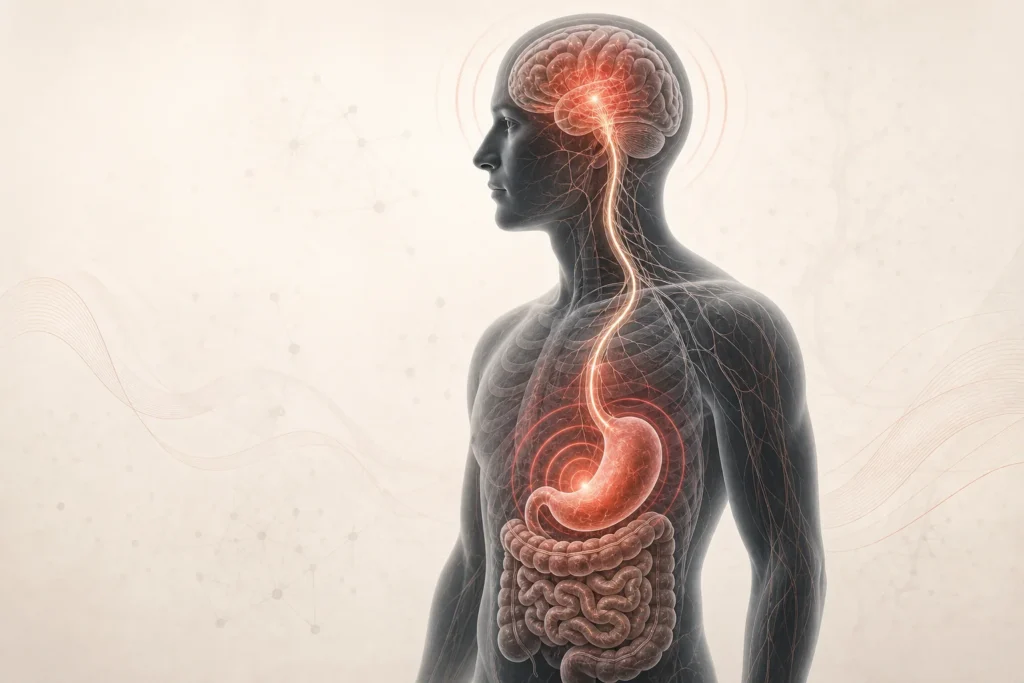
Cannabinoid signaling is a leading research area
Researchers are studying CB1 receptor signaling in the brain and gastrointestinal tract, effects on motility, and the paradoxical shift from anti-nausea to pro-vomiting effects. These models are biologically plausible but do not yet produce a clinical receptor test or a personalized threshold.
Terms such as downregulation or desensitization can describe parts of a theory. They should not be translated into a guarantee that a short tolerance break resets CHS.
TRPV1 may help explain heat and capsaicin responses
Hot-water behavior and limited evidence for topical capsaicin have focused attention on TRPV1 signaling. Temporary symptom relief does not prove the diagnosis or identify the root cause, and not everyone with CHS reports the same response.
Very hot bathing and topical capsaicin also have safety limits. Their possible mechanism should not overshadow dehydration, skin injury, or the need for urgent care.
Individual susceptibility remains unexplained
Only some people with frequent exposure develop the syndrome. Genetics, metabolism, potency, product composition, stress physiology, coexisting conditions, and patterns of use are being studied. Exploratory associations have not produced a validated genetic test or risk calculator.
Demographic or genetic claims should not reassure or diagnose an individual. The clinically useful information remains the episode pattern, exposure history, safety assessment, and response during sustained abstinence.
What mechanism uncertainty means for care
A complete mechanism is not required to stabilize severe vomiting, correct dehydration, evaluate alternatives, and recommend complete cannabis cessation when CHS is suspected. At the same time, uncertainty is a reason to avoid guaranteed timelines, detox claims, and universal treatment rankings.
If symptoms continue despite sustained abstinence or change from the usual pattern, the diagnosis should be reassessed rather than explained through an unproven mechanism.
Continue with a focused next step
- Review current CHS science and open questions
- Understand CHS risk factors and their limits
- Read the complete CHS guide
Sources and further reading
- AGA Clinical Practice Update on CHS (2024)
- Systematic review of CHS pathophysiology
- Review of possible genetic susceptibility
Selected clinical references
- AGA Clinical Practice Update on CHS diagnosis and management (2024)
- Systematic review: CHS diagnosis and treatment
- NCBI Bookshelf: CHS clinical overview
Sources are selected for the topic of this page. CHS SOS provides general education, not diagnosis or individualized medical advice, and does not describe content as medically reviewed unless that is explicitly stated.
Questions readers often ask
What is the main takeaway from “What Causes CHS? The Science Behind the Syndrome”?
Explore how prolonged cannabis exposure, individual biology, and the endocannabinoid system may interact.
How should I use CHS research when speaking with a clinician?
Use research as context for a conversation, not as a self-diagnosis. Bring a clear timeline of cannabis use, vomiting cycles, hot-water behavior, hydration problems, treatments tried, and any periods of complete abstinence.
What should I do next if I am still unsure?
Use the CHS Symptom Check to organize the pattern, review the CHS Action Plan, and bring your timeline to a qualified clinician. Seek urgent care now if severe vomiting or dehydration warning signs are present.
Medical disclaimer: CHS SOS provides educational information and does not diagnose or treat medical conditions. Seek advice from a qualified healthcare professional.

Leave a comment