

People use the term cannabis hangover for next-day fogginess, headache, fatigue, dry mouth, or reduced concentration after cannabis. It is an informal label rather than a well-defined medical diagnosis, and research does not provide one standard symptom list or duration.
CHS is different: it is a recurrent syndrome associated with prolonged cannabis exposure and can progress to severe vomiting and dehydration. Calling repeated episodes a hangover can delay the evaluation that the pattern deserves.
Compare timing and severity
Next-day effects tend to follow a recent dose and improve as intoxication resolves, sleep normalizes, and normal intake resumes. CHS often returns in recognizable cycles and may include a prodromal phase, repeated vomiting, abdominal discomfort, hot-water behavior, and symptom-free intervals. Severe CHS is not simply a stronger hangover.
Do not use one symptom as the test
Dry mouth does not automatically mean dangerous dehydration, and morning nausea does not automatically mean CHS. Look at frequency, duration, cannabis exposure, ability to keep fluids down, and the response to complete abstinence. Other conditions and substances may produce similar symptoms.
- Track each episode instead of relying on memory.
- Avoid driving while foggy or impaired.
- Do not use more cannabis to test whether nausea improves.
- Discuss recurrent symptoms with a qualified clinician.
Warning signs are not a hangover
Inability to keep fluids down, very dark or infrequent urine, fainting, confusion, blood in vomit, chest pain, or severe pain needs urgent medical care. If episodes recur, complete cannabis cessation is an important part of evaluating possible CHS.
Do not use another dose as a diagnostic test
Someone who feels unwell the morning after cannabis may be tempted to use again and judge the cause from the response. That experiment is unreliable: symptoms fluctuate, short-term relief may not address the underlying problem, and renewed exposure can complicate a possible CHS pattern. Record the episode instead of provoking another one.
A one-off period of fatigue, dry mouth, headache, or mild nausea after recent use is different from repeated severe vomiting with substantial long-term exposure. The distinction depends on severity, recurrence, return to baseline, hydration, hot-water behavior, and what happens during sustained abstinence, not on the word hangover.
- Write down the dose, route, timing, sleep, alcohol, and other substances.
- Note whether similar episodes occurred without a recent large dose.
- Avoid driving or safety-sensitive work while impaired or unusually drowsy.
Know when the label is minimizing a medical problem
Persistent vomiting, inability to keep fluids down, very little urine, fainting, confusion, blood in vomit, chest pain, severe abdominal pain, or inability to awaken should not be managed as an ordinary hangover. Seek urgent care and tell the team what products were used and when.
If milder symptoms repeatedly follow cannabis, schedule a clinical review and bring a timeline. A normal day between episodes does not make the pattern unimportant; symptom-free intervals can be part of cyclical disorders and are worth documenting carefully.
Continue with a focused next step
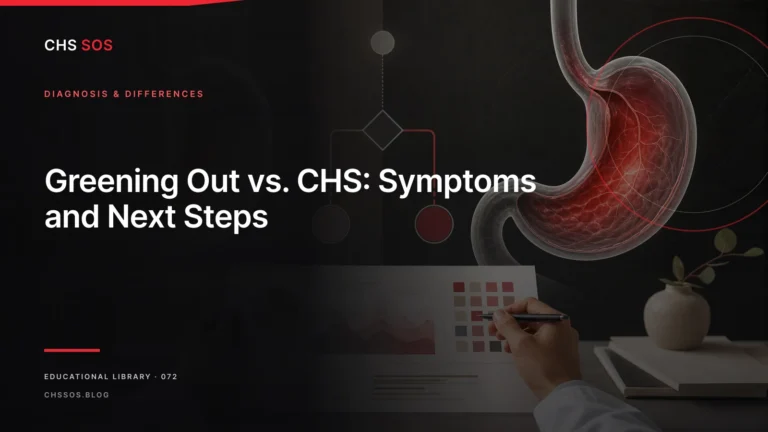
- Compare greening out and CHS
- See when cannabis-related vomiting may be CHS
- Review early CHS warning signs
Sources and further reading
Selected clinical references
- AGA Clinical Practice Update on CHS diagnosis and management (2024)
- NIDDK: How cyclic vomiting syndrome is diagnosed
- NIDDK: How gastroparesis is diagnosed
Sources are selected for the topic of this page. CHS SOS provides general education, not diagnosis or individualized medical advice, and does not describe content as medically reviewed unless that is explicitly stated.
Questions readers often ask
What is the main takeaway from “Cannabis Hangover vs. CHS: How to Tell the Difference”?
A cannabis hangover is an informal description, not a diagnosis. Compare short-lived next-day effects with the recurring pattern of CHS.
Can this information confirm a CHS diagnosis?
No. CHS overlaps with several gastrointestinal and medical conditions. A qualified clinician must evaluate the complete symptom pattern, cannabis exposure, examination findings, and other possible causes.
What should I do next if I am still unsure?
Use the CHS Symptom Check to organize the pattern, review the CHS Action Plan, and bring your timeline to a qualified clinician. Seek urgent care now if severe vomiting or dehydration warning signs are present.
Medical disclaimer: CHS SOS provides educational information and does not diagnose or treat medical conditions. Seek advice from a qualified healthcare professional.
Leave a comment